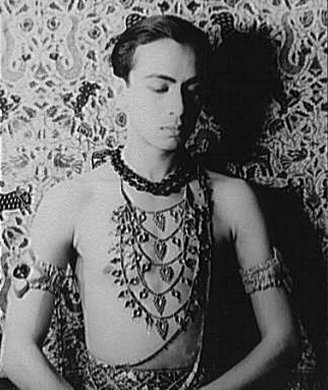
Born into the rich heritage of Kathakali in Kuttanad, a treasure house of performing art forms in southern Kerala, Gopinathan had received training in Kathakali under stalwarts like Chambakulam Paramu Pillai, Mathoor Kunjupillai Paniker, Guru Kunchu Kurup and Chengannur Raman Pillai for seven or eight years before joining Kerala Kalamandalam. He belonged to the first batch of students at Kalamandalam which was opened by the great poet Vallathol Narayana Menon in 1930. His class mates included Krishnan Nair (later, Kalamandalam Krishnan Nair), Sivaraman (Ananda Sivaram), Madhavan (Kalamandalam Madhavan) and Kelu Nair. Great artistes like Guru Kunchu Kurup, Pattikkamthodi Ravunni Menon and Vellinezhi Nanu Nair were among the teachers at Kalamandalam then. Gopinathan, however, joined the American dancer Ragini Devi to form a new dance troupe, with the permission of Vallathol. Ragini Devi had visited Kalamandalam at that time. It later proved to be a great turning point in the history of Kerala's dance forms.
Please type your name along with your comment. Anonymous and derogatory comments are likely to be removed.
Friday, 28 August 2020
Profile - Guru Gopinath and Kerala Natanam - G. Venu
Born into the rich heritage of Kathakali in Kuttanad, a treasure house of performing art forms in southern Kerala, Gopinathan had received training in Kathakali under stalwarts like Chambakulam Paramu Pillai, Mathoor Kunjupillai Paniker, Guru Kunchu Kurup and Chengannur Raman Pillai for seven or eight years before joining Kerala Kalamandalam. He belonged to the first batch of students at Kalamandalam which was opened by the great poet Vallathol Narayana Menon in 1930. His class mates included Krishnan Nair (later, Kalamandalam Krishnan Nair), Sivaraman (Ananda Sivaram), Madhavan (Kalamandalam Madhavan) and Kelu Nair. Great artistes like Guru Kunchu Kurup, Pattikkamthodi Ravunni Menon and Vellinezhi Nanu Nair were among the teachers at Kalamandalam then. Gopinathan, however, joined the American dancer Ragini Devi to form a new dance troupe, with the permission of Vallathol. Ragini Devi had visited Kalamandalam at that time. It later proved to be a great turning point in the history of Kerala's dance forms.
Wednesday, 26 August 2020
Article - Complexion Complexities - Kasi Aysola
Makeup is transformative. Whether it be performance makeup or just a lipstick - we become.
What entails are best practices I have developed over the years of working as a makeup artist. I started doing my makeup myself at the age of twelve. I remember looking at myself and wondering why I looked so angry, only to realize my eyebrows were drawn too aggressively! You live and you learn. My most favorite make overs are the ones that hit home - Indians.
New normal: Dancing behind doors - The Eastern Eye: Column by Dr.Utpal K Banerjee
Since the most trying times are beating this sub-continent down from March last, the performing arts have, among several other domains, perhaps taken the hardest knock. Deprived of its usual soirees with appreciative clientele, all the performances have disappeared from the responsive public gaze and hearing, vanishing with the consequent patronage and succor. These arts are now busy devising their own trysts with technology, to ensure “virtual” space for practice and performance, replacing their physical, audio-visual space they have been used to so long.
Amidst the prevailing conditions and concerns, since each such artiste has to fall back on his or her own resources, this critic felt it was important to take a quick stock of the efforts being made and outcomes being expected, so that there is some mutual sharing of knowledge and taking note of each other's experience and corrective actions. A survey was, therefore, attempted among several major gurus who run large dance institutions in the eastern metropolis, asking them to briefly introduce their dance bodies and respond to the following four questions:
1 - How are you conducting online your teaching / learning classes and exercises?
2 - How do you propose to hold online evaluation / test of the students, after their learning process is over?
3 - How are you planning to produce online performances / hold online seminars / conduct online workshops?
4 - How will you be recruiting online fresh students and assessing their suitability?
The replies received are summarized -- alphabetically arranged under the gurus' names.
Tuesday, 25 August 2020
U..... = You: The reader - Dance Matters: Column by Ashish Mohan Khokar
U. Last of the vowels before I throw in the towel (I'm just rhyming.... Though towels and tissues are very relevant these days of being extra sanitised and sensitised to personal hygiene)...
U= You, the reader. The audience. The recipient of all that is done in the arts, say, our dance field specifically. Are you a rasika? Are you a patron? Are you a viewer or reviewer willing to surrender to art more than the artiste? Are you willing to support the arts? Are you willing to buy a ticketed show? Are you really interested (enough to leave 10% in your will, to cause of art and artistes)? Are you ready to suffer "bad" shows? Are there any bad shows or philosophically speaking, nothing is good or bad, it just is?
Monday, 24 August 2020
Book Review - Celluloid Classicism by Hari Krishnan, Wesleyan University Press - Joël Riou
This review of a book is an invitation to the Bharatanatyam dance fraternity to engage seriously with the history of this dance form. Doing so requires nuance, care and awareness of its complexity as it is woven with many different layers. On the one hand, some discourses place the origin of Bharatanatyam into an idealised ancient past of sacred dance, but on the other hand, almost all the repertoire that is eulogised as traditional originates in court practices, especially from the Thanjavur Maratha Kingdom. Yet, shortly after a social “reform” jeopardised the way of life of hereditary practitioners, an élite initiated a so-called aesthetic “revival” in the 1930s. These categories were wonderfully examined in an article published by Amrit Srinivasan in 1985, Reform and Revival - The Devadasi and Her Dance. Nowadays, some people are still using the trope of “degeneration” in order to legitimize a cultural appropriation.
Saturday, 22 August 2020
Article - Empowerment through Bharatanatyam - Tejsree Beharee
Throughout the world, there are male dancers who excel in fields such as modern dance like hip hop and popping and locking.We are all accustomed to watching talent dance shows where the male dancers, in all their muscular cast present those modern dance styles, under the enthralled gaze and cheers of the audience as well as the jury members. But what about the place of Indian classical dance in empowering men? Traditionally, most performers of Bharatanatyam are female; not to say that there are no male Bharatanatyam masters around - far from it. This begs the question: "Can Bharatanatyam be a means to empower men?"
'Empowerment' is a word widely used, but often hard to define. It seems like every individual or party has defined the word by taking inspiration from their personal experiences. To shed light on the matter, the Division for Social Policy and Development (DPSD) of UNDESA (United Nations) created an online survey to ask people all around the world about the definition of empowerment (Department of Economic and Social Affairs Division for Social Policy and Development, 2012). Sandra Lincoln, a Province Leadership Team Member of the Society of the Holy Child Jesus, quotes: "Empowerment is to give a person the confidence and education and where-with-all to be all that they can be." Kenneth Schadt, a History and Literature tutor defines the word as, "Power to achieve political, social, and economic equality...", and Donal Horowitz from the Federation of Jewish Men's clubs explains that, "Empowerment means that people, individuals have a voice in making decisions for themselves and for society." To summarize, it can be said that empowerment is the ability that enables an individual or a community to exercise control and power to attain a certain target, and in the process, they are helping themselves and other people (Adams, 2008).
Thursday, 20 August 2020
Some refreshing moments on Internet - Taalam: column by Leela Venkataraman
With tastes tailored to watching live programmes, it is only lately, thanks to the pandemic that one has been forced to take in virtual discussions and exchanges, and while one must admit to still finding it difficult to watch traditional dance performances online, one must admit to some totally unexpected, interesting moments – in some of the interactions.
One such episode sponsored by Jaywant Naidu from Hyderabad on ‘Remembering Ram Gopal’ with two main participants, namely critic and dance historian Sunil Kothari and veteran Kathak guru and performer Kumudini Lakhia provided some unintended moments of fun. After Jaywant’s introduction, Sunil Kothari, as is his wont, was voluble with his diarising and volley of information on Ram Gopal, stressing on the fact that what Ram Gopal danced was vintage ‘classical’ – and that he was one of the earliest known dancers responsible for popularising Indian classical dances to western audiences. Following this strong reference to Ram Gopal’s classical credentials, Kumudini Lakhia in her forthright fashion butted commenting that since she had to fulfil another commitment, she would like to have her say before leaving.