Please type your name along with your comment. Anonymous and derogatory comments are likely to be removed.
Friday, 20 November 2026
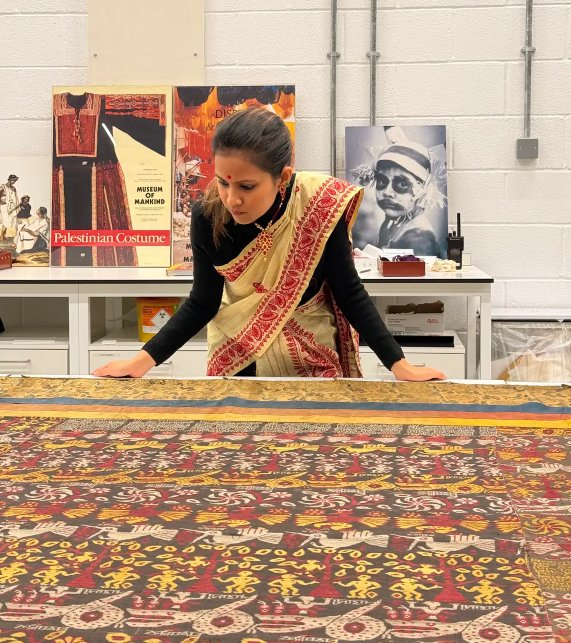
Prism - Vrindavani Vastra: In Britain, still carrying the heart of Assam by Anannya Mahanta Jugnarain
Wednesday, 18 November 2026
Article - Vedanta Lahari - Weaving philosophical inquiry through Natya by Rohit Viswanath
How, then, might abstract philosophical inquiry find expression through Nāṭya, not merely as an idea to be understood, but as an experience to be encountered?
This question lay at the heart of Vedānta Laharī. Bringing together six presentations across Bharatanaṭyam, Odissi, Mohiniaṭṭam and Kuchipuḍi, the programme sought to explore whether aesthetic experience could offer a glimpse of spiritual transcendence through Rasāsvāda. Its successive dance presentations approached this aspiration through different philosophical sources, devotional orientations and artistic vocabularies.
Please type your name along with your comment. Anonymous and derogatory comments are likely to be removed.
Tuesday, 17 November 2026
Article - Two Traditions, Similar Rhythms: Mishra Chapu Taala and Poritaal by Ayush Dutta
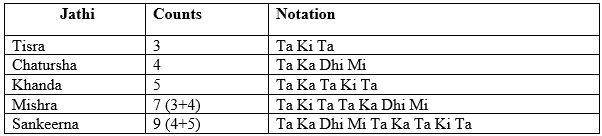
In the Carnatic music system, there is a comprehensive framework of seven fundamental rhythm specifications, which is called the Sapta Taala. These seven core rhythmic structures are further categorized into five standard syllable divisions, collectively known as the Pancha Jathis. These jathis actually show the matra structure of the taala system:

Following this basic overview, the article focuses on Bharatanatyam and Sattriya -- two of the eight Indian classical dance forms, to show close comparative analysis between Mishra Chapu Taala of Bharatanatyam and Poritaal of Sattriya. This comparison reveals the profound structural similarity between two dance forms that follow distinct musical systems.
Please type your name along with your comment. Anonymous and derogatory comments are likely to be removed.
Monday, 16 November 2026
Profile - Parwati Dutta's world of Art and the unceasing quest for excellence by Dr Chitra Sharma
Kathak and Odissi exponent Parwati Dutta is an artiste who envisioned a magnificent dream -- not merely of establishing her own artistic identity, but of nurturing and advancing both these classical dance traditions. Remarkably, she chose to pursue this vision in a place where neither of these dance forms had an established tradition. That place was Sambhajinagar, formerly known as Aurangabad.
It was here that Parwati Dutta transformed her grand vision of MAHAGAMI, an institution dedicated to the arts, into a foundation for the propagation and flourishing of dance. The path was arduous, for the region had no existing tradition of these classical dance forms upon which to build. Yet, she drew inspiration from a profound verse of the Rigveda, whose philosophical essence conveys: "A cosmic command emerged, and from the darkness came the luminous birth of Truth. Thereafter arose the waves of the ocean; from those waves emerged Time, the year, followed by night and day, through which even the smallest measure of time -- the blink of an eye -- came to be determined." In essence, the creation of the universe from nothingness unfolded through a gradual and continuous process.
Please type your name along with your comment. Anonymous and derogatory comments are likely to be removed.
Friday, 13 November 2026
Profile - Aarohi SanchAri: A student-built stage for young classical artistes by Pooja Khandelwal
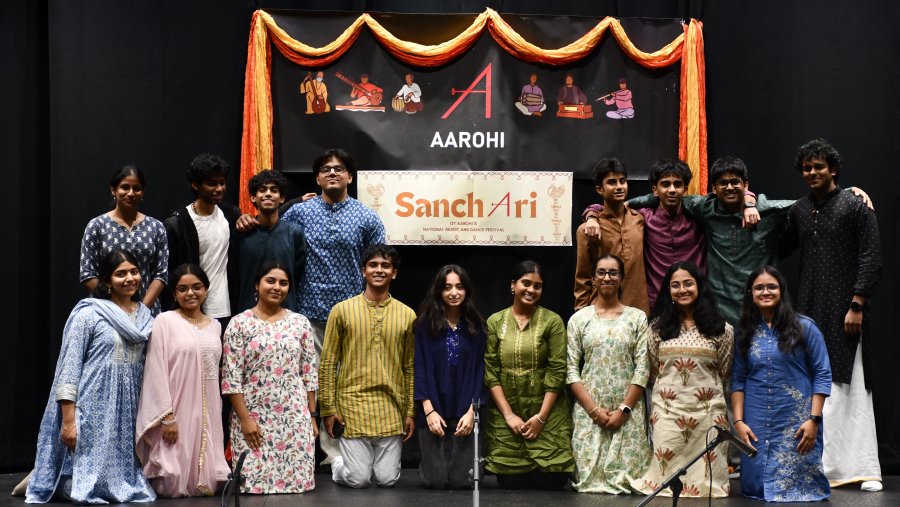
More than 70 young artistes applied to perform at the inaugural Aarohi SanchAri Music and Dance Festival, held at Georgia Tech in Atlanta on October 31 and November 1, 2026. Thirty-four took the stage, presenting Carnatic music, Bharatanatyam, Kathak, Kuchipudi and Odissi. They came from 14 U.S. states, from Boston to Portland and the San Francisco Bay Area to name a few.
What sets SanchAri apart is who built it. Many festivals for young classical artistes are organised by gurus, academies or cultural institutions. SanchAri was conceived, curated and run entirely by students of Aarohi, Georgia Tech's student organisation for the Indian classical arts.
Please type your name along with your comment. Anonymous and derogatory comments are likely to be removed.
Tuesday, 10 November 2026
Captivating folk and classical dance expressions of Call of the Beloved in KNMA's dance festival - Taalam: column by Leela Venkataraman
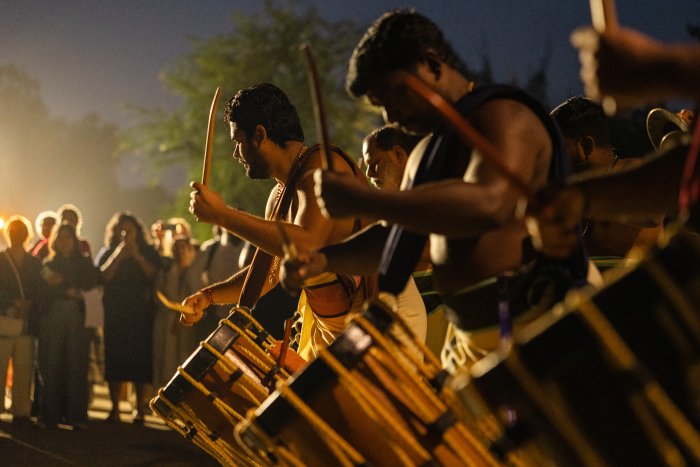
Even after he had burnt Kamadev to ashes with the fiery power of his third eye, Shiva, unable to totally eradicate desire, is compelled to revive his victim as the formless one - and Kama continues to incite passion and intoxication through his unseen presence in the sweetness of wine or on a moonlit night when the air of bountiful Spring beckons to lovers. At the Sunder Nursery, the four day KNMA festival of dance (Oct 15 to 18), aimed at fostering a deeper connection between arts and the community at large, wove the event round the theme of the 'Call of the Beloved' as conceived by festival curator dancer Leela Samson. In the expanse of the open air amphitheatre, the brilliantly illuminated stage setting bordering the rear, had a Picasso like abstract geometrical mosaic of a multi-layered, dynamic assemblage of oblong shaped wooden cutouts, arranged at varied fragmented angles, which, looking very modern, made one wonder if dance forms of traditional genres classical and folk, even in their contemporary manifestations, would clash with the theme of the layout, particularly in such a large performance space. But senior finished dancers, aided by lighting expertise, managed to keep the focus on the performance. The disadvantage came when, away from the center, notwithstanding the galleried seating, one was relegated to a side seat in the amphitheater with its semi-circular seating arrangement. With dancers focusing on interpretative numbers where abhinaya demanded a frontal view, some in the large audience, unable to find a vantage point, left in disappointment.
Please type your name along with your comment. Anonymous and derogatory comments are likely to be removed.
Article - Arts Management 101 by Sankriti Krishnan
"An arts manager? What exactly does an arts manager do?"
That surprised curiosity is not entirely unfounded. For many, the job title is still quite new to hear and the field of work behind it even more so.
Take a play or a theatre production you've seen. As the audience, we see the actors, the sets, the lights, the costumes and the story unfolding onstage. What we don't necessarily see is the work that made the production possible - securing a venue, bringing together the cast and crew, coordinating rehearsals, raising funds and securing sponsorships, managing budgets and contracts, working with creative and technical teams, promoting the production and bringing an audience into the room. Long before the curtain rises and even after it falls, there is an entire framework of people, planning and resources, working behind the scenes to support what happens onstage.
This is where arts management comes in.
Please type your name along with your comment. Anonymous and derogatory comments are likely to be removed.
Sunday, 8 November 2026
Article - When Ghungroos rang at Disney World by Samyuktha Gopiraj
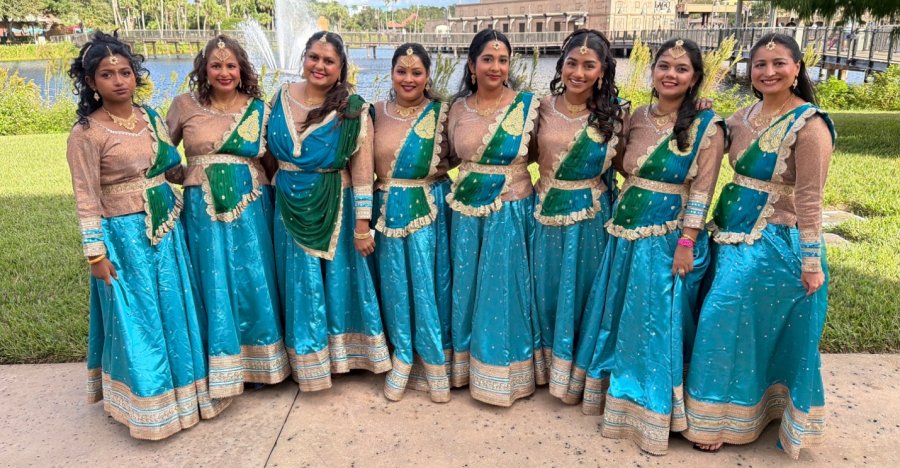
Ghungroo Dance School Inc., a small studio from Santa Clarita, California, was one of 25 companies selected from over 600 applicants worldwide to perform at the Diwali Dance Fest 2026 at Walt Disney World Resort. Organized by Jashn Productions, the fourth annual festival brought together more than 500 dancers from four continents for a four-day celebration of South Asian dance and culture (October 22-25), with over 1,100 participants and guests. Ghungroo performed in both the Grand Parade and the International Dance Showcase. I was one of those dancers. This is what it felt like.
Three days, Three Parks
The festival unfolded across Walt Disney World - each day with its own character, each park offering a different stage.
Please type your name along with your comment. Anonymous and derogatory comments are likely to be removed.
Thursday, 5 November 2026
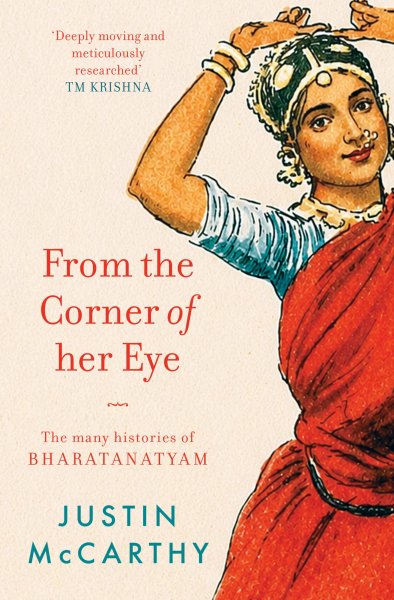
Book Review - From the Corner of Her Eye: The Many Histories of Bharatanatyam - Dr. Ragothaman Yennamalli
In 2008, I watched a performance by Lokesh Bharadwaj, choreographed by Justin McCarthy, in which Tyagaraja's kriti Endaro Mahanubhavulu was reimagined as a padavarnam and performed with remarkable finesse. The novelty, as one might assume, was not simply in using this particular composition as a padavarnam. Rather, it lay in the imaginative use of space, the structuring of korvais, and the integration of dance elements into a piece steeped in bhakti. So, I was pretty excited to know what's new being written in the book, and at the outset the book didn't disappoint me.
The premise of the book is that it has become increasingly difficult to separate fact from fiction in the widely circulated, and often reductive, histories of sadir or chinna melam and the subsequent reinvention of the form as Bharatanatyam. Over the last decade or so, multiple voices have pushed a largely binary view of Bharatanatyam: Rukmini Devi Arundale versus Balasaraswati, Sringara versus Bhakti, a hoary past versus a reinvented dance form, and so on. For some reason, reducing a complex history to such binaries seems to have become the norm rather than the exception. This book has attempted to bring such discussions with the needed nuance.
Please type your name along with your comment. Anonymous and derogatory comments are likely to be removed.
Wednesday, 4 November 2026
Article - The resonance of nine: Cosmic geometry, subtle anatomy, and the cathartic architecture of Bharatanatyam by Dr. Lata Surendra
This paper investigates the profound metaphysical, mathematical, and physiological architecture of the number nine within Hindu traditions, mapping its manifestations across cosmic symbols, natural elements, and classical arts. By focusing specifically on the structural geometry of the classical dance form Bharatanatyam, this study illuminates how the human frame transforms into a living mandala. It correlates the intricate networks of seventy-two thousand nadis, or vital energy channels symbolized by the ceremonial offering of the betel leaf or tambula, with the numeric digital reduction to nine. Furthermore, the analysis explores how the compression of cosmic forces is mirrored ritualistically in the deployment of the betel nut or supari within the navagraha grid, and scripturally through the planetary, durga, and nagic slokas with systematic textual references. Finally, this work details how a conscious dancer strategically maneuvers these geometric templates, moving from the chaotic action-reaction outbursts of unawakened daily life into a disciplined aesthetic focus. Through the precise kinesthetic activation of the navarasas, or the nine fundamental expressions, the performer initiates a deep neurological catharsis that cleanses the neural pathways of both dancer and spectator. The final resolution into shanta rasa, or absolute peace, represents the ultimate spiritual baseline where all worldly passions are spent, and the macrocosm seamlessly merges with the universe within.
Please type your name along with your comment. Anonymous and derogatory comments are likely to be removed.
Tuesday, 3 November 2026
Article - Charukesi: The bittersweet ocean of love to pure Krishna consciousness, A perspective on music, movement, and the mind by Bana Shastri Ramanath
Life is often likened to a journey of highs and lows, roses and thorns, and bittersweet moments. As we age, memories may fade, yet the sensations of pain and pleasure can remain, leaving fossil-like impressions within us. Perhaps this is why older faces sometimes carry fleeting, childlike smiles touched with melancholy, as emotions pass effortlessly and involuntarily across them like images appearing on a screen. Is the mind quietly revisiting a lifetime of triumphs, disappointments, joys, and sorrows? I often wondered about this while watching my parents, both of whom lived to nearly 100.
These reflections returned as I prepared for a dance performance. I searched for a song gentle enough for my injured knees, yet powerful enough to stir my consciousness and convey love, joy, melancholy, and warmth. I also wanted the music to evoke the painless healing I have occasionally experienced during and after my performances. When mind, body, and feelings move in harmony, merging as one with the music, I have experienced that the mind can become so absorbed in the process that pain seems to dissolve, for a time. Those experiences have inspired me to explore and share how music and dance can transform a lifetime of mixed memories into a more peaceful, expansive form of love through artistic expression, a moving meditation.
Please type your name along with your comment. Anonymous and derogatory comments are likely to be removed.
Monday, 2 November 2026
Bharatanatyam constructs built round philosophy of Jyotirlingam - Taalam: column by Leela Venkataraman
Please type your name along with your comment. Anonymous and derogatory comments are likely to be removed.
Sunday, 1 November 2026
Anita says...November 2026
October moved like a single restless current between three cities. In Kolkata, the pandals rose in astonishing variety, each one a temporary palace of craft where bamboo, cane, cloth, metal and light were shaped into everything from intimate street shrines to towering architectural fantasies - the makers' skill turning devotion into pure spectacle. In Madrid, the staccato of flamenco jostled against the late night pulse of churros and hot chocolate - heat and music spilling from plazas as if the city refused to go indoors. Finally, the Venice Biennale that offered rooms with a quieter intensity, where contemporary art sat in careful conversation with the lagoon's shifting light.
One month, three kinds of looking, and the shared pleasure of watching human hands, minds, bodies and imagination at work.
Please type your name along with your comment. Anonymous and derogatory comments are likely to be removed.