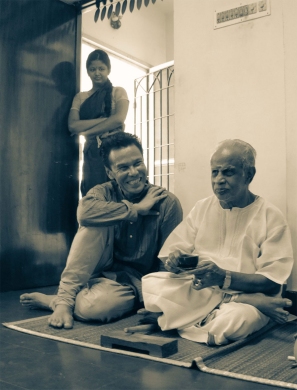
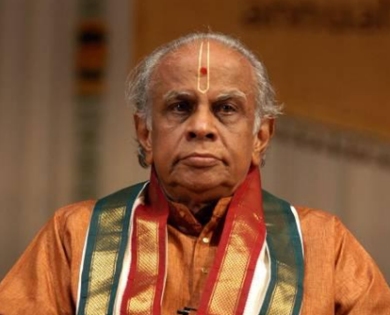
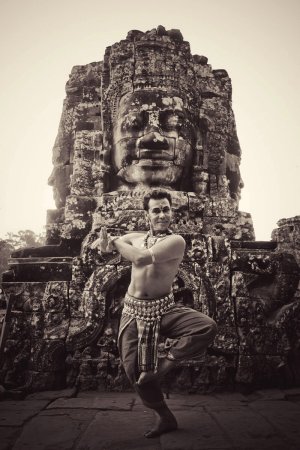
When my Bharatanatyam guru Adyar K Lakshman died on the 19
August 2014, he left a rich legacy of dance repertoire for
posterity. However, an era of Bharatanatyam left with him.
Not many in Malaysia know that Lakshman Sir had a profound
influence on a generation of male dancers in Malaysia.
When Malaysians discovered that both Chandrabhanu and I
studied under him, many aspiring Malaysian dancers
especially male students, made a bee-line to his dance
studio, in Gandhi Nagar, Adyar (Chennai). They came in
droves hoping also to get the same training that Chandra
and I had been privileged to undergo.
Read the tribute in the site
The Oxford Dictionary describes modern as: Contradistinction
to classical/tradition; of the present times, just now,
existing, pertaining to the present and recent times,
contrasting to an earlier form.
In any field – design, architecture, films, music – modern
means a new language, which is distinguishable from old,
something new and something that holds as modern. In
Indian dance this is very complex and often the most
misunderstood word. What part is modern and what part is
Indian? Is fusion leading to confusion? Are traditions
being sacrificed for something western? Are
non-government funding agencies and journalism teaching
schools, subverting Indian classical traditions just to
pander to western powers or next trip to Germany or Guyana?
Presently, Indian modern dance or modern dance in India is
neither Indian nor modern. Using traditional forms like
Kalari and Chhau, adding western costumes and music does
not make it modern. Modern means a whole new language,
which appeals and is understandable. Not just decorative
dance as many dance groups are trying to do. New does
not mean modern though modern can be new. Newness is in
structure and substance of art, in its content. Modern is
often mistaken for contemporary. Contemporary dance is
a reflection of a society at a given point in time. Every
generation has a contemporary response to everything:
fashion, film, design, dance, music, painting but it does
not necessarily mean it is modern.
Read the article in the site
One of the most illustrious of Bharatanatyam dance mentors
passed away on the 19th of August 2014.
Adyar Lakshman or
Lakshman Sir, as he was known to his students, who are to
be found all over the world, developed an extraordinary
method of teaching Bharatanatyam. I consider myself most
fortunate and blessed to have studied with him and to have
inherited this ingenious method which stressed thorough
knowledge of dance practice and theory, music and rhythm,
the thematic narratives of the dances, nattuvangam, and
the ritual contents of the dances. Despite his great
achievements, my guru remained a man of great humility,
always crediting his own gurus, Rukmini Devi Arundale, and
several others, for the development of his artistry.
Unlike so many of the new generation dance teachers, he
did not profess to know everything. Rather, if he did not
know the answers to some questions asked by his students,
he would say he didn't know, and would we go and research
on these subjects and come back to inform him.
Read the tribute in the site

Guru Debaprasad Das,
one of the foremost gurus of Odissi dance, had developed a
unique style of his own with stylised abhinaya and
naturalistic approach to the dance form. ‘Sabda Swara
Pata’ is an important feature of his style and retaining
Odissi dance in its purest form was his most important
contribution. He kept a low profile, died at the age of 54
and his star disciples strive hard to propagate and
popularize his not often seen tradition. Gayatri Chand,
one of the accomplished senior most and technically sound,
devoted Odissi dancers in Debaprasad Das’s style has
painstakingly collected a large amount of detailed
information of her guru and his work from resources far
and wide and with a paramount effort and research, has
compiled and classified them in the first ever written
illustrated book on her guru entitled ‘Guru Debaprasad
Das: Icon of Odissi.’ The remarkable feature of the book
is the analysis and classification of the text and music
and statements on the style of her guru as compared to the
other two stalwarts (Late Gurus) of Odissi (pg 44). With
an extremely convergent and focussed mind she has
gracefully pointed out the details without causing any
damage to the honour or respect of others’ thoughts, ideas
or principles.
Read the review in the site
B. Herambanathan is
the senior most choreographer and dance teacher of the
Thanjavur nattuvanga tradition. He is the son of T.G.
Bhavu Pillai (a Bharatanatyam teacher, mridangist and
Bhaghavatha Mela drama teacher who was a much sought after
accompanist to dancers of the past) and Jeeva Amma (a
dancer). He is the son-in-law of devadasi Doraikannu and
is proud to hail from a lineage of devadasis belonging to
the Thanjavur region.
He trained under his father, T.M. Arunachalam Pillai and
K.P. Kittappa Pillai in Bharatanatyam, under N. Rajam Iyer
in mridangam, under Balu Bhagavathar and P.K. Subbaiyer in
Bhagavatha Mela. He began his career as a Bharatanatyam
choreographer from 1967. He accompanied as mridangist for
the arangetrams of his father’s students. The arangetram
of his first student S. Rohini was held under the
presidentship of K.P. Kittappa Pillai on Feb 8, 1970 in
Thanjavur. He serves as a teacher for the Melattur and
Saliyamangalam Bhagavatha Mela dance programs.
Read the profile in the site
The Arts play a
vital role in building the character of a nation. When we
mention the Arts, we associate it synonymously with
culture. To a layman, art generally equates with beauty
and excellence. Culture, on the other hand, has to do with
the traditional, the way of life of the people and the
endeavours which are representative of the collective
psyche of society.
The Arts inevitably mirror society and plays the role in
engaging society to look at itself as it evolves towards
being more civilized. The universal message of Arts is
inclusive but at the same time is opened to personal
interpretation and represents an enigmatic challenge in
its engagement with society. Together with the Humanities,
the Arts promote the quest of self-reflection, celebrate
the miracle of life and cultivate the positive
transformation of the human race. Due to this, the
Arts have a moderating influence on society. This
‘civilizing’ process, which is a prime consequence of the
presence of the Arts, also informs us of the directional
path of the society towards a progressive and better
quality of life.
Read the article in the site
It is always a
pleasure to watch a Bharatanatyam recital by a seasoned
dancer like Leela Samson. After seeing her delectable
recital one wants to see more. As a mature dancer with an
excellent track record, training in Kalakshetra and imbibing
the aesthetics and values of life from Rukmini Devi and
other teachers, Leela epitomises certain qualities, which
reflect in her dance. That sets her apart from other
dancers.
Performing in an ideal setting of Sannidhi auditorium of
Gandharva Mahavidyalaya, the ambience created a magic of its
own. Intimate and cosy, the auditorium makes it easy to
watch the subtle nuances registered on the face of the
dancer. It adds to the relish of the aesthetic experience.
That Leela was in excellent form is stating something
obvious. Recalling her earlier performance at Sannidhi when
it was inaugurated, she said that she was very happy to
perform again after 2009, as she had left for Chennai by
then. Her long and intimate association with Gandharva
Mahavidyalaya, Bhai-ji and entire family has been very
precious for her. Before performing shlokas describing Lord
Shiva’s preparation for marriage from Kumarasambhavam’s 7th
sarga, Leela said she had approached Madhup Mudgal - Bhaiyya
as she addresses him - to compose music for those shlokas.
Madhup set it to Vibhas raga and Leela said that this is one
of her most favourite numbers.
Read the review in the site