Pt. Guru Sundaralal Gangani passed away on auspicious kartik poornima,
on December 17, 2013, in his home town of Baroda. Scion of Jaipur
Gharana, he was brother to Guru Kundanlal Gangani. Between them, they
trained scores of Kathak dancers in Baroda, Delhi, USA. Anjani
Ambegaonkar, Dharamsiji Shah, Shovana Narayan, Prerana Shrimali,
Rajendra Gangani, sons Harish and Jagdish Gangani are some of their
serious disciples. They have trained many more.
Read the tribute in the site
When I was the
convener of the Natya Kala Conference in 1995- 96, Krishna
Gana Sabha audience gave the best lecture demonstration
merit award to both Swapnasundari and A. Janardhanan.
After that, it has taken all these years for them to be
elevated to Nritya Choodamani and Acharya Choodamani. My
hearty congratulations to both of them.
Read the article in the site
Continuing on theme and subject of banis (thanks to spin-off
of Alarmel Valli’s Oct. focus on her own bani, of which she
is a worthy representative) I bring to you two artistes –
Aniruddha Knight, grandson of the great Bala and Murali
Mohan Kalva, grand student of Sunderlal Gangani. Aniruddha
represents the Bala bani (Balamma, in figure of speech, left
the Tanjore bani - to which she was born - far behind and
even surpassed it) and Murali Mohan Kalva has taken the
Jaipur gharana far ahead.
Read the review in the site

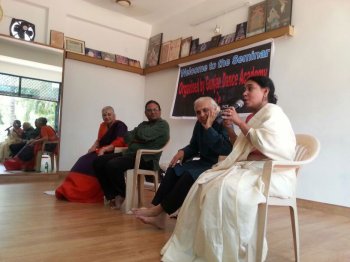
Meera Das, senior disciple of Guru Kelucharan Mohapatra
based in Cuttack assiduously continues Odissi training at
Cuttack, though the dance scene has shifted to the
capital Bhubaneswar in a big way. Kala Vikash Kendra,
the premier institution started training of Odissi dance at
Cuttack, where Kelucharan Mohapatra taught Odissi to several
young dancers, including Kum Kum Mohanty (nee Das),
conducted workshops when dancers from different parts of
India and some from abroad came to study Odissi. Later,
Odissi Research Centre was established at Bhubaneswar and
many Odiya dancers studied there under Kelubabu, including
Meera Das, who did not settle down in Bhubaneswar. She chose
to open her institution Gunjan Dance Academy at Cuttack in
1995 and has trained more than 200 young dancers at her
academy. Last year I had attended its 16th annual festival
and was impressed by her dedication and determination to
carry on the legacy of her guru in Cuttack. Once upon a time
it was Kala Vikash Kendra which drew many to its portals to
study Odissi. Today, Meera Das with her dynamism and
catholic outlook has succeeded in keeping the interest among
people in Cuttack alive in Odissi through her academy and
several events she organizes.
The three day dance and music festival she conducts features
well known dancers practicing different classical dance
forms and provides platform to young up and coming talented
dancers as well. With a band of her dedicated supporters,
including her President Gayatri Das, local committee
members, her senior students, some of whom with thorough
training under her, also take classes, teach and perform,
and poet and critic Kedar Mishra, Meera Das continues to run
her academy successfully.
Read the review in the site
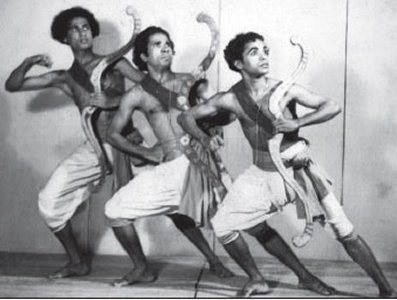
Discovery of India, dance drama choreographed by Dr. Sandhya
Purecha was staged at the Nehru Centre, Mumbai on 21st
November. Based on Pandit Jawaharlal Nehru’s vision it was
choreographed first by Shanti Bardhan in 1947 and was later
choreographed by Guru Acharya Parvatikumar in the 1950s both
of which were produced by the Indian National Theatre. More
than fifty years later, the Nehru Centre produced this dance
drama. Sandhya Purecha, a senior disciple of Acharya
Parvatikumar conceived this timeless saga of Indian history
and evolution on the occasion of Nehru’s 125th birth
anniversary and the first death anniversary of Acharya
Parvatikumar.
The audience response was overwhelming. The leading lights
of the city including artistes, scholars, government
officials including Ashutosh Ghorpade, Director, Directorate
of Cultural Affairs, Govt. of Maharashtra, Dr. Uma Vaidya,
Vice- Chancellor Kavikulaguru Kalidas Sanskrit University,
Ramtek, late Guru Parvatikumar’s wife Sumati Parvatikumar
were present. The music score composed by Manoj Desai and
arranged by Mandar Parkhi resonated in the hall. The music
with catchy tunes, beats and blending of eclectic musical
instruments unfolded every era of human history right from
the Stone Age to the post-independence period of India.
Read the review in the site

Esplanade on Bay at Singapore wore a festive look for ten
days from 15th November with Kalaa Utsav, Indian Festival of
Arts as a part of various festivals Esplanade organizes for
celebrating New Year of various communities, to strengthen
the community harmony among the multicultural population.
Now in its 10th year, Kalaa Utsav has grown in its dimension
ranging from classical dance performances, vocal and
instrumental music, theatre and three day fest to ten days
bonanza of multiple arts and several venues embracing
literary, visual, performing arts and popular arts including
free outdoor performances at concourse and outdoor
auditorium, some events with free admission, drawing a
continuous stream of visitors, aficionados, artists,
musicians, literary figures, authors, writers, workshops,
exhibitions of photographs, textile installations,
discussion on Ayurveda, the science of life and what have
you. Like its counterparts in USA, London, Avignon, Perth
and Adelaide, Esplanade on the Bay in Singapore consists of
venues right from the Grand Theatre to Library esplanade,
including Concert Hall, Recital Studio, Theatre Studio,
Rehearsal Studio, Outdoor Theatre and Concourse. Mind
boggling events are scheduled bringing international
artistes from near and far with a clever mix of local
talent.
The most fascinating event that I witnessed was a
collaborative work sponsored by Esplanade as a co-production
‘Angkor: An Untold Story,’ a dance-drama, with Apsaras Arts,
a Singapore based reputed institute offering training in
classical Bharatanatyam and allied arts, under the
supervision and direction of Neila Sathyalingam, Founder,
Artistic Director and mentor. She and her late husband S
Sathyalingam have lived and taught dance and arts at Apsaras
Arts since 1975. Neila reiterates the fact that
Singapore’s relentless pursuit of excellence in all aspects
keeps focus on National Arts Council’s (NAC) aim of
nurturing artists, musicians, dancers, painters and
sculptors.
Read the review in the site
Two key events - poles and miles apart – one in Madras and
the other in Bhubaneswar, in October, made me delve into the
concept and context of banis and gharanas. Both, rather
commonly used but easily misunderstood words. The one event
in Madras was ‘50 years of Alarmel Valli’s dancing career’
which she had the class to celebrate by not dancing
herself (as dancers often generally do!) but she platformed
others (with help of upcoming journal and impresario
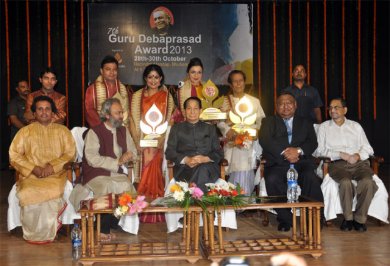
Aalaap). The other event was in Odisha, where the guru
bhakti of Guru Gajendra Panda made him mount the 7th
Debaprasad Das Award with a 3-day music and dance festival.


Both events were miles apart in content and context but both
celebrated the concept of gurus and banis – one in
Bharatanatyam and the other in Odissi. Both platformed the
art of their gurus, as handed down to them: Alarmel Valli, a
star legatee of the Pandanallur bani and Gajendra Panda, the
solid legatee of Guru Debaprasad Das. Both didn’t dance
themselves but platformed other artistes instead, whom they
thought fit for the occasion. Alarmel Valli presented the
current music flavor of Madras sabhas, TM Krishna, and the
Delhi Odissi diva, Madhavi Mudgal with her niece
Arushi. Gajendra Panda presented and awarded Delhi’s
best known Bharatanatyam dancer Geeta Chandran; Chennai’s
activist-artiste Anita Ratnam; Seraikella
Chhau’s Shashadhar Acharya and senior Odissi Guru
Sudhakar Sahoo. The Governor of Odisha did the honours, no
less. And in Madras, film-maker Rajiv Menon gave the keynote
address.
Read the article in the site