A Bani is the result of a creative process where a mind is
engaged in reconstructing an art discipline to a certain aesthetic
elevation by breaking the existing norms akin to a system practiced. The
conceived mind here, leads to a customization of a whole new system of
stylization. This pursuit of the mind may be subjective for others at
that time of conception, but it will certainly lead to becoming a
milestone for the art form itself, through successful performances of
practitioners. Here, a Bani gets established. The established Bani carries a distinct identity that can be traced based on the social background and geographic location.
In a more specific sense, a
Bani can be understood as the
discipline applied on the art form in terms of practice. To cite an
example in the Carnatic music tradition, a Bani or a school may be
identified either based on the richness in Bhava, or when it is more inclined towards exploring the laya vyavahara, or when the focus is concentrated on intricately webbing a raga alapana while rendering a kirtana. For ex. in Veena Dhanammal Bani, we will see the elaborate exploration of raga along with interludes of laya, an Ariyakudi Ramanuja Iyengar school had more emphasis laid on the laya aspects than on raga alapana. Or later, in a Semmangudi school – the rendition of a kirthana strictly maintained a pad’athi in its gamakas that was passed on generation after generation, while in a Madurai Mani Iyer’s school, the rendition of kirtanas allowed a certain artistic freedom which itself can be called a pad’athi. The above examples explain different Bani-s(schools)
with regard to musical pedagogies. Similarly, for dance forms, the
pedagogical differences in imbibing the art form as a practice would be -
the musical genre adopted by the nattuvanar-s, the characteristics of nritta and nritya
elements in the dance, the continuing signature of the founder (passed
down) in the tradition; all put together become the yardstick in
defining a school.
Read the article in the site

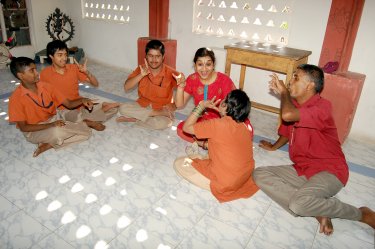
Ever since I was a little girl I was exposed to the wonderful art forms
of dance and music. I always got so much from them that I believed
strongly in dance and music being far more than ‘merely’ performing
arts. Structured dance and music and their performance is, I believed,
and believe, only a part of the whole. For me, in the movement of
the trees, the leap of the deer, the prancing of the waves, in the
laughter of children, in the tears of the afflicted and expressions of
the proud parent…In every single movement of the universe, there is
dance and in every single sound there is music.
My belief would have remained a belief, but for god giving me
opportunity after opportunity for reinforcing my belief and helping me
structure dance, music and drama into a methodology that does not only
result in performance but goes far deeper seeking and fulfilling every
developmental need of an individual. From 1982, when I started working
with the visually impaired children at Ramana Maharishi Academy for the
blind, Bangalore and in 1985 when I volunteered to teach dance and music
to children of Spastic Society of India (now Vidya Sagar) till I
started Rasa – Ramana Sunritya Aalaya in 1989, I found fulfillment in
structuring and documenting the new methodology of holistic self
development which I first called C.M.E. (Creative Movement Education)
and later changed the term to T.H.D (Theatre for Holistic Development)
for it covered the scope of the methodology more fully.
Read the article in the site

The first edition of a welcome international dance festival in Singapore
aiming at covering Asian classical dances was flagged off with an
interesting performance by Priyadarsini Govind, one of the leading
lights of India’s Bharatanatyam performers and the enfant terrible of
Carnatic music, vocalist TM Krishna from Chennai. Generally, Carnatic
vocalists do not sing for a dance recital. But here are two vastly
gifted dancer and musician of present generation who have boldly
attempted to explore classical dance and music together, none trying to
upstage each other, but work together with a deep understanding of the
two forms, with mutual respect. And the artistic experience has been
something which one relishes with great delight, going along with them
with curiosity and its successful denouement.
All this and many other concepts were offered on a silver platter by
Singapore based renowned Bharatanatyam exponent Gayatri Sriram,
whose Shrutilaya institute was the producer of the festival
organized by Jyoti Ramesh, whose passion for dance, music
and performing arts has found an ideal expression in event
management. Presenting sponsor was the Bank of Singapore (BSi), in
collaboration with the Jade group, and with support from
various agencies, the three day festival from 14th till 16th September
2012 at The University Cultural Centre, National University of Singapore
(NUS), was a runaway success.
Read the review in the site

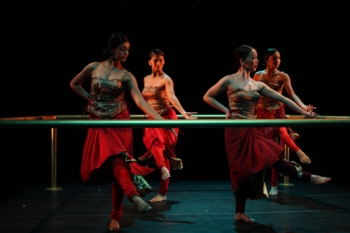
Sutra Foundation’s Tarikan Dance Festival 2102 featured two new
choreographic works under the title ‘Transfigurations’: ‘Panjara’
choreographed by Sutra’s Rathimalar Govindarajoo and ‘She Ra’
choreographed by Dutch born Kalpana Raghuraman (Korzo Theatre, The
Hague). I caught up with the last performance of these two works on 2nd
September 2012 at KLPac Studio 2 at Kuala Lumpur, managing to arrive
from Singapore in time.
Ramli Ibrahim had informed me that these two works examine myths - the
archetypes of mythology and how their avatars perpetuate these in our
contemporary psyches in various transfigurations. Ramli’s and Sutra
Foundation’s creative journeys are not limited to the traditional,
classical Indian dance forms. In his early youth, Ramli had performed in
Sydney Dance Company at Sydney Opera House in modern choreographic
works of Graeme Murphy, a leading choreographer from Australia. Poppy,
choreographed by Graeme featured him in a decadent tango, a multi media
dance theatre based on the life and times of Jean Cocteau. That was in
1978. Ramli has since then choreographed and performed several
contemporary works within Malaysia and abroad.
Read the review in the site

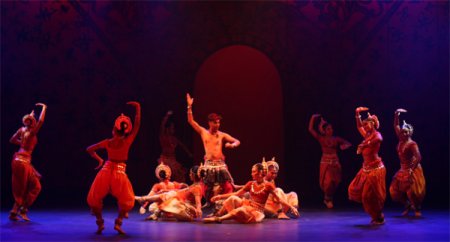
Watching five pallavis in different ragas, of legendary gurus like Deba
Prasad Das, Pankaj Charan Das, Kelucharan Mohapatra and the younger
gurus like Durgacharan Ranbir and Gajendra Panda, by disciples of Deba
Prasad Das was an exhilarating experience at Panggung Exsperimen
Theatre, University of Malaya, on 7th September 2012, as a part of Ramli
Ibrahim’s Sutra Foundation’s Tarikan Dance Festival 2012.
Like a jeweler, RamIi has redesigned these pallavis with imagination
investing them with newness and arresting beauty. These are rearranged
for group composition by Guna and Ramli and they capture the attention
of the audiences the moment the very first strain of musical instruments
is heard. Sivarajah Natarajan’s set design, with back drop of
patterned flowers and arches, reminding one of the arch of Rani
Gumpha cave sculpture, and exquisite, at times diffused and at times
effulgent, lighting of various hues and colours, evoking different
moods, and in consonance with music and movements takes one’s breath
away. There is such wonderful rapport among the choreographers, the
dancers and the lights designer, built over many years that the entire
production from the word go to the end, mesmerizes the onlookers.
Read the review in the site
Dance has been part of nature from the resurgence of life itself.
Dance has slowly and steadily evolved from mere expressions of joy and
sorrow, to celebration of life, to exposition of rituals and belief
systems, to evolution of human psyche. When I was virtually
traversing through this dance hierarchy, it was the most humbling
experience to realise the expressions of great minds that have soared
higher than the mundane existence and recreated and represented subtle
truths through their evocative expressions.
Dance once was just the simple venting of one’s inner feelings which
later became a medium of storytelling. It was an oral tradition
unintentionally recording our history, culture and traditions. As human
mind evolved, these expressions acquired new horizons and newer
meanings, accentuating on theories of Rasa (aesthetics). It became
a gratification for the senses and akin to enlightenment for the soul.
Read the article in the site

Italian by birth, Dr. Ileana Citaristi holds a Doctorate in Philosophy
with a thesis on 'Psychoanalysis and eastern mythology.' She came to
Indian dance after years of experience in the traditional as well as
experimental theatre in Europe. An exponent of Odissi and Mayurbhanj
Chhau, Ileana has made Odisha her home since 1979. She learnt
Mayurbhanj Chhau under the guidance of Guru Hari Nayak, obtaining the
title of ‘Acharya’ from the Sangeet Mahavidyalya of Bhubaneswar in
Orissa. A senior disciple of Odissi Guru Kelucharan Mohapatra, she
founded Art Vision in 1996 with a group of artistes belonging to
different disciplines such as dance, music, painting and literature to
share creative ideas. One such is Kalinga Mahotsav, a national festival
for martial arts organized with Odisha Tourism Department at Dhauli
Stupa from 2003.
The Art Vision Academy conducts classes in Odissi and Chhau. The
performing unit has performed in many prestigious conferences and
festivals in India and overseas. Ileana Citaristi’s contributions,
besides the many performances and lec-dems include articles on Oriya
culture published in Indian and foreign magazines, research work for
film documentaries on Odissi and Chhau dances and practical dance
workshops for dancers and theatre workers which she regularly conducts
on invitation from different institutions in India and abroad.
Read the interview in the site