Monday, 18 May 2020

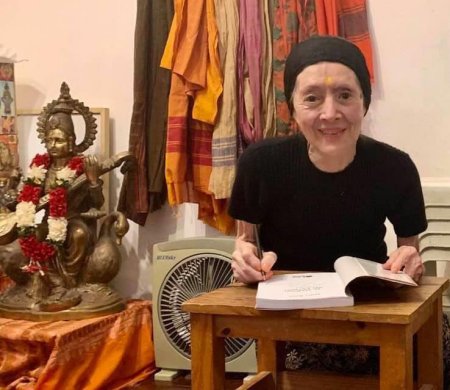
Obit/Tribute - Myrta Barvié (1933 -2020) - Silvia Rissi


Myrta Barvié (13 January1933 – 15 May 2020) was a pioneer in spreading the knowledge of the classical dances of India in Argentina and Latin America. As a dancer, writer, lecturer and teacher, she presented this art in its most classical, pure and traditional form, just as she learned it in India with her teachers.

Myrta was a classical ballet dancer, beginning her studies at the age of 8 with the Russian teacher Victoria Tomina who advised her to enter the dance school of the Colón Theater in Buenos Aires. At the age of 14 she joined the permanent dance company of the Colón Theater, where at the age of 17 she debuted as the first dancer in the role of Swanilda of the ballet Coppelia. Shortly thereafter, she made her first trip to India at the invitation of Rukmini Devi, director of the most important dance institute in South India, Kalakshetra. Thus Myrta began the most beautiful and profound relationship with India, its art, wisdom and spirituality.

Read more in the site

Thursday, 14 May 2020

Article - Abhinaya Darpanam in a nutshell - Dr. Maithili Nesargi-Naik

There exists a beautiful garland of 324 pearls strung together with the silken thread of nrutya shastra in the ancient Sanskrit literature -The Abhinaya Darpanam.

Abhinaya: To express / To take forward to

Darpanam: Mirror

Abhinaya Darpanam is a Sanskrit treatise on Indian classical dances having a detailed account of dance movements and expressions.

The entire text is composed in poetry (padya) form. 'Anushtupa chhand', 'Sragdhara' and 'Shardulvikridit' are the predominantly used meters for the composition of Abhinaya Darpanam. This padya format facilitates the 'memorizing and recitation' method of gaining knowledge. In the traditional Indian system of education, 'Patha-Anushthan-Avabodha' was the sequence one followed to gain knowledge. The author of the work is Nandikeshwara who is believed to hail from southern India.

Read more in the site

Tuesday, 12 May 2020

Dance distorted during pandemic - Taalam: column by Leela Venkataraman


We are now living in a world of the internet where all manner of teacher/taught relationships have gone for a toss- not excluding the performing arts. A sea change indeed for the dance world we have loved to proudly tout as 'classical', where at one time, the Guru/shishya interaction was through 'Gurukula Vaasam' - considered the sine quo non for learning! The constant physical proximity of living in the home of the Guru (nothing less) paved the way for the student unconsciously imbibing the intricacies and totality of a tradition covering aspects not discussed in the formal classroom training.

All Gurus, this writer has spoken to, are unanimous that the live classroom with the throb of the students' response is the most effective adrenalin driving the Guru's teaching enthusiasm and with such responses as an aspect largely to be imagined on internet teaching, the task is made more exacting. Unlike music classes on Skype which have been in practice for some time, dance which involves the moving body seems to pose more problems. Says Aruna Mohanty, the Odissi dancer/teacher, "I am constantly itching to pat and straighten a slightly hunched spine, lift a sagging shoulder or correct a body slant in the wrong direction - while constantly realising that in this virtual proximity physical contact is impossible." She has now taken to making diagrams of the right body posture, the way knees are to be placed, and even the line that the hand movement traces in space. "My pictures show the starting position, the middle position and finally the concluding point showing exactly how the hand should move."

Read more in the site

Sunday, 10 May 2020

Poem - What is dance to you? - Tejsree Beharee

What is dance to you?
I am often asked!
Sometimes it is a prayer
Offered daily
Where I express my gratitude and I ask for positivity in life

Read more in the site

Friday, 8 May 2020

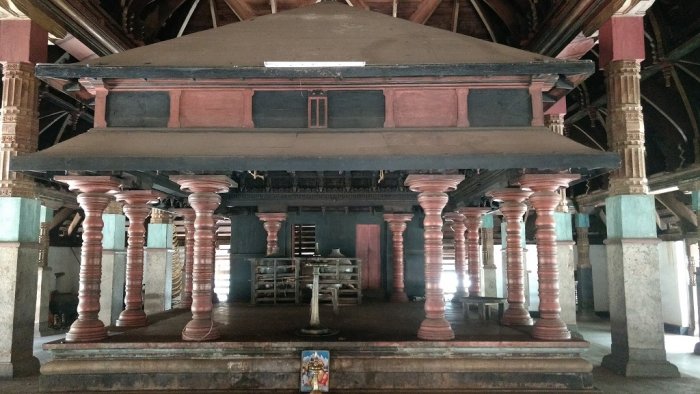
Article - Koothambalam: The performance theatres in Kerala temples - Haritha Haridas


Concept of a Koothambalam
The Koothambalam or Nrtta Mandapa came into existence during the day of Bharata. Bharatamuni in his extant Natya Sastra has in fact written an entire chapter on the construction of an auditorium for theatre. Though there is a legend associated with the necessity of an auditorium, practically Bharata believed in providing a specifically erected enclosed space for theatre to make it more aesthetic. Earlier, there were not any particular spaces for performing arts; performances were conducted in any open space or on temporarily erected stages and even on streets.

Read more in the site

Friday, 1 May 2020

Roving Eye curated by Anita Ratnam - May 2020

Anita says...May 2020

We will not go back to normal
Normal never was.
Our Pre Corona existence was not normal
Other than we normalised greed, inequity, exhaustion
Depletion, extraction, disconnection, confusion,
Rage, hoarding, hate and lack.
We should not long to return my friends.
We are being given the opportunity
To stitch a new garment.
One that fits all of humanity
And nature.

- Dr. BRENE BROWN
School of Social Work, University of Houston, Texas

What do I say that has not already been said, seen and performed during these part 30 days?
I am so fed up with my phone and my iPad. I am sick and tired of desperate dancers performing in their non photogenic homes just so "they are not forgotten." I have seen so much bad dancing, especially Bharatanatyam, that it has turned me off this wonderful form for a while.

Dance is about human interaction. It's about the sweat and the panting and the effort and the exhaustion. It is about the exhilaration and excitement of having completed a phrase, an item, a performance, a rehearsal well. It is about the RASA of human eyes watching another human body in the same physical space and not through the cold, glassy eye of the camera. It's also about embracing and being applauded by actual audiences and not by "likes" and "heart" emojis.

I have enjoyed the riches of the world's greatest museums and cultural spaces. Operas, ballets, online tours, ancient history talks, cooking lessons, language lessons - my days have been filled with so much that I did not feel one day blurring into the next.