Entertainment is an activity performed to hold an audience's attention with the purpose of delivering pleasure.Dance is a performing art form consisting of purposefully selected movements with a symbolic aesthetic value.Classical means a representation of an exemplary standard within a sufficiently long-established form or style.Considering these definitions, a classical dance performance can be defined as: A standard form or style of purposefully conceived movements that are specifically selected with the purpose of keeping an audience's attention. This, however, alters the meaning and intention of a classical dance performance.As I sat to watch an extravagant spectacle of a classical dance production by an extremely popular classical dance company from Bangalore, whose dancers are revered as young stars, I could not but help observe aspects that now dictate the intention of this process, its consequences, and its success factors.
Read more in the site
It is either everything or nothing when it comes to performance opportunities for a dancer in India. Performance space has been cornered by a handful of dancers who in most cases have had the good fortune to combine talent with power to influence the right decision making forces. Make no mistake; the latter has a big role to play in the scheme of things.What happens within the Guru/shishya teaching and learning arena remains largely outside reflection in the performance circuit. Which is why Ashok Vajpeyi, under the Raza Foundation umbrella of activities, very astutely started Uttaradhikar series for the young dancers, many of who would seem to struggle endlessly for platforms to perform. He is providing a regular platform (at least once a month) but on the recommendations of the Guru, who ultimately will be judged on the basis of the student's calibre. Two day events feature one promising young musician and one dancer every evening.
Read more in the site
Femme Fatale has usually been a pejorative term in the English language. But in the Dionysian world of theatre - first celebrated for the god of wine in ancient Greece -- Femme Fatales could very aptly describe the brave feminine front that has emerged in the two theatre-conscious metropolises. In Delhi, this critic knew the quartet of fiery female directors from the charmed circle of NSD: Neelam Mansingh, Anuradha Kapoor, Kirti Jain and Tripurari Sharma who have, together, created virtually a creative storm in the world of avant garde theatre in Hindi, and Joy Michael of 'Yatrik' in English theatre. In Kolkata, following the exemplary footsteps of the iconic Tripti Mitra - whose directorial oeuvre, beginning from Dakghar (1957), her solo classic Aparajita (1971), her Hindi ventures Guria Ghar (1980) and Sanjh Dhaley (1985), up to her last direction, Sarisrip (1987) had created waves among the cognoscente -- the suave Sohag Sen appeared and there has been no looking back ever since.If one attempts a very brief recapitulation of the thirteen major women directorial talents active today in the Kolkata drama scene - in no particular chronological order -- whose impact on Bengali theatre has been nothing less than an artistic Tsunami, Sohag Sen would stand foremost, with her forte in depicting urban middle class. Having directed plays by dramatists as varied as Mahesh Elkunchwar and Botho Strauss, her association with theatre and allied media spans a period of almost sixty years. As an actor, she started her career under the guidance of the legendary Utpal Dutt in the year 1969 and her latest directorial venture Chhota Chabi (reviewed in these columns), was very well received in 2019.
Read more in the site
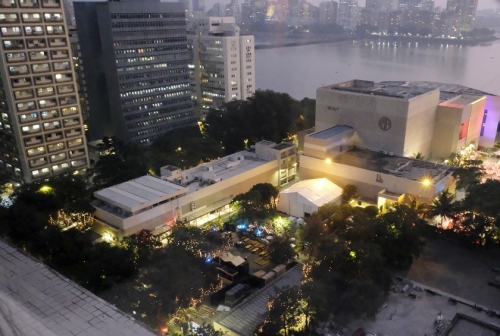
On 28th November all roads led to Nariman Point to National Centre for the Performing Arts in Mumbai. The occasion was the grand celebrations of 50 years of the Centre. Associated with NCPA for more than 40 years, it was for me a sentimental journey. The large crowd of aficionados, dancers, musicians, painters, drama directors, actors, music lovers, in particular from the Parsi community, moved to Jamshed Bhabha Theatre, the large auditorium named after Jamshed Bhabha, the patron and Trustee of NCPA. Almost modeled on the Garnier, Paris Opera House, with two side marble staircases and imposing foyer, it was bustling with who is who of Mumbai's art loving public.
Read more in the site
(An earlier, slightly shorter version was presented at the Ocean Dance Festival, November22-25, 2019, at Chittagong, Cox's Bazar, Bangladesh, under World Dance Alliance-Asia Pacific)PropositionIt is a truism that, both individually and collectively, one tends to grow with time and change accordingly. Individually, one comes to grips with sex; grows to fathom the meaning of death; and so on. Collectively, the whole society changes with time. It is proposed that as a collective genre, classical dance of Indian sub-continent should relate to changes in their environment and discard MYTHOLOGY as their enduring 'sahitya' since the latter has lost its relevance to modern times. Classical dance - while fully carrying forward its techniques and treatment, and its highly developed aesthetics - should communicate to the modern society for deriving its contents for 'sahitya', as other sub-continental visual and performing arts have done in the recent years.
Read more in the site
Undeterred by years of choppy sea winds steadily weathering its stone carvings, Konark Temple stands as an architectural poem of unparalleled magnificence in salutation to the Sun God. The Konark Festival of Dance, with a massive open air stage overlooking the tiers of the Mahamandapa (the only part of the temple fully intact) in the distant backdrop, initiated by the Odissi Research Centre as a small beginning in 1969, has grown into a mammoth event held under the auspices of Odisha Tourism Department and the State Sangeet Natak Akademi, attracting tourists from all areas. With Chinese lanterns and tombas hanging from trees and buildings, and Pant Niwas lit up, the small township has a buzz, looking decked for a wedding. Walking through illuminated gardens and pathway decorated with large Rangoli patterns, one reaches the open-air auditorium with a seating capacity of 5000, which not infrequently, is filled to near capacity watching the dances.
Read more in the site
Sangeet Natak Akademi awardee (Kathak) for the year 2017, Dr. Shobha Koser has been a catalyst in promotion of Indian arts and culture at large. An exponent of the Jaipur Gharana, she has been a prime disciple of the stalwart late Guru Kundan Lal Gangani, learning from him several gems which the Jaipur style of Kathak is famous for. Zest for teaching and imparting these age old traditions at heart, Shobha Koser has been actively involved for decades in rendering arts education through her renowned institution Pracheen Kala Kendra in Chandigarh.
A doctorate in dance from Punjab University, we interact with Shobha Koser at length about her artistic journey, her will to propagate arts, and what it takes to be an artist.
Read the interview in the site