The Kakatiyas, the second major dynasty of the Andhra region after the Satavahanas, were ardent patrons of art. Dealing with the classical and the regional dance forms of the Kakatiya period is the 13th century treatise Nrtta Ratnavali written by Jayasenapati, who surprisingly was the commander-in-chief of the elephant corps (gajasadhanika and senapati as the author himself puts it) serving ruler Ganapati Deva (1198-1262), between whom and the author existed an intimate bond with Jayappa becoming his brother-in-law. It was 'Ganapati Bhupala', who noting the talent and loyalty of young Jayana as he is referred to, put him under the right tutelage to be taught fine arts! And significantly the thousand pillared 13th century Ramappa Temple at Palampet (now declared a world heritage monument) near Warangal, the capital of the Kakatiyas built out of special floating bricks was by the then Chief of Army and Minister of Ganapati Deva.Its extensive inscriptional and sculptural evidence pointing to the dance forms existing in this region inspired Jayappa while writing Nrtta Ratnavali. This would seem to point to an era when dance was a popular art form attracting people from all disciplines - not excluding the army! Jayappa's deep respect for Bharata and the Natya Sastra are reflected in the starting chapters on classical dance. In fact, he mentions that were Bharata to come back and reflect upon what he, Senapati had written, he would be very pleased at how completely faithful he, Jayana had been to Bharata's Natya Sastra! The later chapters deal with Desi or regional dances and here one sees the influence of Sarangadeva who belonged to about the same period, and is the author of the Sangeeta Ratnakara which also dealt with the Desi forms.
Read more in the site
(Paper presented at the "Purush-ang" seminar organized by Central Sangeet Natak Akademi at Bhubaneswar on September 19, 2000)An important role in the formation of what we define today as Odissi dance was played in the first half of the 20th century by male artistes belonging to the performing art scene of those days. At the time when the devadasi tradition had come to an end and the gotipua tradition was looked upon as cheap and vulgar, a group of talented and versatile stage artistes infused new life into the dying dance scene.The emergence of the present day Odissi cannot be totally understood unless we place it in the context of the fertile atmosphere which the theatre movement of the first half of the last century and the artistes behind it provided. Among the artistes were Mohan Sunder Dev Goswami, Ramachandra Mania, Laxminarayan Patra, Lingaraj Nanda, Kartik Kumar Ghose, Brindavan Das, Kashinath Sahu, Durlav Chandra Singh, Kalicharan Patnaik, and Dayal Sharan. They were totally dedicated and committed to the cause of reviving the performing arts of Orissa. Each one of them was an exponent of more than one discipline, like music, drama direction, dance or stage craft and each one was a self made artiste, having acquired whatever expertise he had, more by observation than by undergoing a systematic training.
Read more in the site
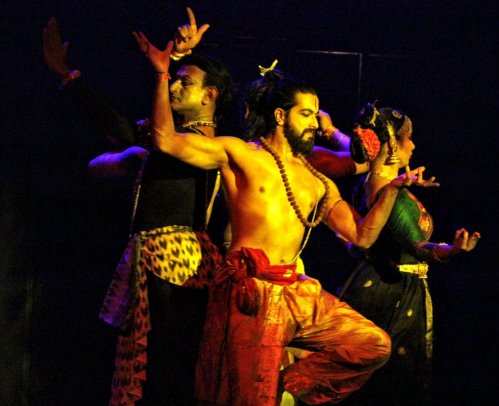
There is no doubt that with Trayambakam, the latest choreographic work of Rasa United, Vanashree Rao has emerged as a brilliant choreographer. From a soloist and performing Kuchipudi with her husband Guru Jaya Rama Rao, her forays into choreographing works in three styles - Bharatanatyam, Kuchipudi and Mayurbhanj Chhau - with a brilliant group of male and female dancers, Vanashree sets the stage on fire! There is not a single dull moment throughout the presentation. It grips the audience from the word go. The electrifying dances by the male dancers to the pulsating music, mood lighting and excellent costumes, the visuals hold one's attention.
Read more in the site
For those who believe they cannot dance, here is a way to tick that off your bucket list. A recent paper by researchers at the University of Berkeley provides insight into how they could transfer moves from a dancer onto a person who could not dance. The result - a seriously impressive dance by an untrained amateur. While Artificial Intelligence (AI) has thus far been able to recreate voices and faces, dance was a new high. Although it involved impressive deep learning algorithms with a multi-step transfer process, the product mapped the bodily motion from a trained dancer to a novice very convincingly.
Read more in the site
In the early 1960s, Martin Luther King II announced, standing under the shadows of Abe Lincoln’s Memorial in Washington, DC, to the Blacks of the States: I have a dream… Over half a century later in the late 2010s, Vikram Iyenger too declared, standing beside the ruins of the dilapidated Gem Cinema in Central Kolkata, to the art-lovers of the eastern metropolis: I have a dream…If King had contemplated the much larger domain of freedom from the bondage of slavery for his people, the vision of Iyengar, a renowned Kathak dancer groomed under Rani Karnaa, was: “A hub for the practice, discourse and presentation of dance and movement-work in Kolkata … a space to think, know, talk, imagine dance … a home in a country that boasts of innumerable movement expressions from dance to martial arts.” He elaborated, “This is the big dream, and we invite everyone to join us on this adventure...”Unlike the American Black’s freedom from bondage, Iyengar’s habitat for the art of dance has not yet materialized, the Gem’s site having proved to be too huge and too ramshackle, and there being no other site currently in view. Yet, Iyengar and his ‘Pickle Factory’ – a name he coined from a chance visit to a Chinese friend’s factory for manufacturing sauce – have pressed on regardless in their quest. Meanwhile, since 2018, Pickle Factory has been offering a delectable dance fair to the dilettante of the city. Only from August 2018 to October 2019, there have been 30 programmes; artistes have participated from the USA, the Philippines, Lithuania, Switzerland, China, Wales and Australia, apart from India; there have been 11 partners and 8 venues have been explored in Kolkata, Delhi and Bolpur (Shantiniketan). This critic witnessed three major events and here is the overview.
Read more in the site
"Every day brings you the chance to take a deep breath, kick off your shoes and Dance
When you hit a wall, climb over it, crawl across it or just dance on top of it."- Oprah Winfrey
We live in an age of crass cacophony. When a 29 year old priest slaps a 50 year old female devotee right in front of the sanctum in the CHIDAMBARAM temple and immediately flees the scene, we are staring at a scenario where there are no safe spaces and no automatic sanctuaries. When the #METOO accused just one year ago are not just roaming around scot free but also performing in several December sabhas and receiving awards, we are facing a dire landscape of broken rules and splintered hopes.It is not enough anymore for our politics to be separate from our art. No amount of dancing and praying to Shiva, Vishnu, Krishna, and Devi can sublimate the anarchy of our times. No shouting and screaming about disrobing Draupadi or humiliating Sita will suffice. The praise of BEAUTY is just not enough anymore. For our art to be in sync with our lives we must embrace the turmoil of our times and find a way to enfold it in our artistic practice.
Read on...