Audience - the most important factor for any Bharatanatyam performer. We
grouse about the audience a lot. We want them to come in large numbers
and yet, have absolutely no idea how to lure them performance after
performance! It seems that the success of a performance and the
performer is so dependent on the audience turnout that one of the first
post-performance thoughts for any dancer would be the proverbial “Oh! I
wish there were more audience to watch me...”
Who are these audiences anyway? Observation and logic will lead to the following categorization of the audience
Read the article in the site
“Today, this book is in front of you. It is a bundle of my passion, my
struggle, my experiences and my sentiments.” These last lines of the
book authored by Mumbai-based Kathak exponent Uma Dogra aptly sums up
her “labour of love” carefully and honestly crafted over the past five
years.
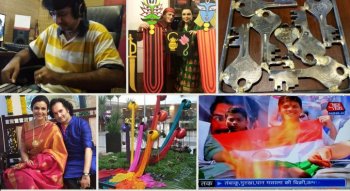
The well-known dancer-choreographer-scholar, a much respected name in
Mumbai’s artistes’ fraternity, released the book during a very special
occasion that she hosted in Mumbai recently. It was the 25th edition of
the annual Pt.Durgalal Festival that she has been staging in memory of
her guru. It was also the Silver Jubilee celebration of Samved Society
of Performing Arts that she had founded. And, most importantly, it
coincided with 50 years of her journey as a dancer.
Read the review in the site
Bereavement has more than one side to it. The death of a loved one, the
passing of a beloved and inspiring teacher, the huge loss that death
brings to us when such death comes unexpectedly. These and similar
thoughts assailed me during the funeral of my father and guru Sri
Kelucharan Mohapatra. My loss was two-fold. I had lost a father and I
had also lost my most revered teacher. The father who sustained me in
childhood through years of toil and poverty and the teacher who taught
me all I know and whose teaching continues to motivate me through the
many years that have passed since his
demise.
Read the article in the site
Our dances, particularly Bharatanatyam relies on Mukhaja
Abhinaya.....facial expressions. Kathakali and Koodiyattam are
disciplines which give proper and elaborate Shastra- based training to
students on the use of eyebrows, eyes, facial muscles and so on. After
all that training they cover their faces with thick elaborate make-up,
so much so that if we are not close enough we cannot observe the range
of this type of expression. Strangely, Bharatanatyam gurus of the old
tradition did not impart training in facial expressions. They only used
to say - maintain a pleasant expression during nrtta. And as for
abhinaya , the gurus showed the correct hastha mudras , the linking
moves with the arms, the glance (yatho hastha thatho drishti), the
spatial body movement, the rhythm of the feet in synchrony with song and
tala. All, practically seated, and rarely getting up! We understood the
flow of the sequence, learnt the lyrics and assumed appropriate
expressions with very few tips from the gurus. When I think of my gurus,
I don't seem to recollect any special lessons for facial expressions.
The intuitive grasping of the idea, mood, etc. was our test. We asked no
questions like......Sir, why can't I do this gesture with my left hand?
....or ...must I move only diagonally to do this particular phrase? ...
Or … Sir, how do I show sadness with my face? We just did it. Letting
you do your own was the secret of those gurus’ success.
Read the article in the site
Dance is an art wherein through ‘language of gestures’ it communicates
the thought processes and emotional bearings of the ‘spirit.’ Dance is
the medium of spiritual expression, to communicate the joys and sorrows
of life, where the instrument is the human body and mind. The teacher
trains the student and helps the student to integrate body and mind
through cadences of body movements set to rhythm and express ideas,
emotions or emotional experiences of the inner self.
A teacher trains the students in an art form by giving instructions on
the practical aspects of the art i.e., performance of the art, duly
supported by theoretical knowledge of the subject matter. Various means
and measures are devised to provide the technology of the art which can
be called the methods of teaching. These methods vary from teacher
to teacher.
Teaching of foreign language and language of gestures
The researcher is trying to access the methods and approaches of
teaching a foreign language for teaching gesture language of dance since
both are skills of communicating acquired through study, practice and
habit formation.
The essentials for a method of teaching of a language, according to W.F.
Mackey is, “A method determines ‘what and how’ much is taught, the
‘order’ in which it is taught, ‘how the meaning and form’ are conveyed,
and what is done to make the ‘use of the language unconscious.’ Thus a
method deals with four things: viz. selection, gradation, presentation
and repetition.” [1] The lessons are selected to suit the level of
education of the learner; it is graded according to the maxims of
teaching and with the understanding of the psychological makeup of the
student. It is presented in a manner so that the concepts and techniques
are conveyed with sensitivity and are made habituated through repeated
practice or repetition and drill.
Read the article in the site
"Success is the best deodorant!"
- Hollywood actress Elizabeth Taylor
It was a strange month. There was so much excitement and OTT
expectations from so many quarters. And mostly outside the world of
dance.
A family wedding of my favourite niece had me prepped with all guns
firing as a producer of several events. Planning and executing weddings
today calls for nuanced management and people skills. Indian women
have it as a natural ability and it is mostly undervalued and
unappreciated. I have to admit that my many years of producing weekly
television shows and later creating and staging my own dance works and
festivals over the past 35 years has more than equipped me for the
vagaries of human ego, erratic behaviour and substandard vendors.
Read Anita's message in the site