In those early classes, even the simplest sollukattu felt like trying to speak a new language. Now, in World Dance class at the Buckley School, Sherman Oaks, CA as we all work through complex beats together, I find myself quietly drawing strength from years of practicing tisram patterns, grateful for this foundation that helps me understand new rhythms. When working through the World Dance choreography, I silently thanked my guru for the years of rhythmic training that helped me understand these new patterns.
Please type your name along with your comment. Anonymous and derogatory comments are likely to be removed.


My dearest Samu,
ReplyDeleteBEAUTIFULLY WRITTEN ARTICLE!
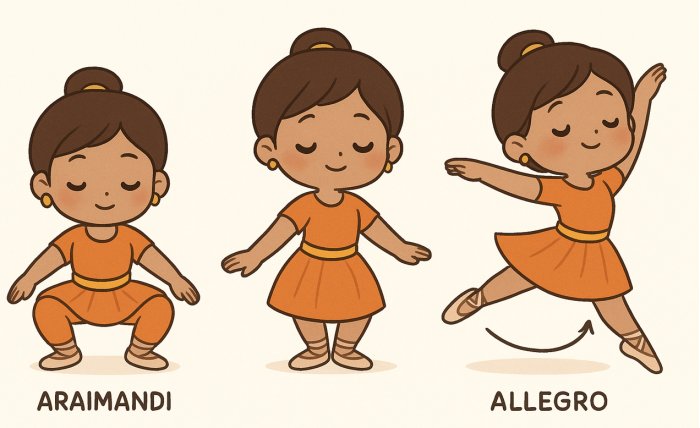
First of all,I would like to appreciate your PICTORIAL REPRESENTATION OF A LITTLE GIRL PERFORMING ARAMADI AND TRANSITIONING TO ALLEGRO.It is such a thoughtful and creative way to show the connection between two different dance genres.
It is very heartening for me to know your training in Bharathnatyam from your tender age of just five has empowered you to perform complex footworks in other dance forms as well.SAMU,THE SECRET OF SUCCESS LIES IN CONSTANT PRACTICE.,and you are a wonderful example of dedication from a young age, blossoming into talent,skill,confidence and versatility.
I am also proud to know that you are exploring other dance forms in the WORLD DANCE CLASS at your school.Although my own knowledge in dance is limited,one thing I can certainly say is BHARATHNATYAM IS ONE OF THE MOST CHALLENGING CLASSICAL ART FORMS.Training in it gives a strong foundation,making it easier to learn and adapt to other styles.
I especially loved your comparison BHARATHNATYAM MOVEMENTS TO MATHEMATICS.Your quote “EVERY JATHI IN A THALAM BEAT IS A FRACTION AND EVERY SEQUENCE IN FOOT WORKS AND GESTURES IS AN EQUATION “is very apt and interesting.
It is fascinating to see how you connect the rhythmic and complex Bharath natyam patterns to jazz style.Your explanation of “Dance is story telling “ is beautifully expressed.
I appreciate your interpretation of THALAMS in music and mridangam ,and how you channel these rhythmic patterns to suit jazz is really admirable.It shows depth,creativity and ability for intuitive understanding of both classical and contemporary forms.
Indeed,classical art forms beautifully meet the contemporary,and your article captures that harmony wonderfully.
Keep it up and God bless you
Samu very beautifully written! I like how you have drawn parallels between Bharatanatyam and other dance forms and your appreciation for the hours and years of practice for the foundations of dance. They say that training in any classical dance form helps one to pick up any other dance form relatively easier later in life. I see that in you! The pictures you have drawn showing Araimandi help us visualize what you are explaining. I love how you see the same rhythmic patterns across different global genres of dance and reflecting on the foundations you learnt as a child. I am proud to see your growth and achievements over the years! Keep up the good work and consistency!
ReplyDelete