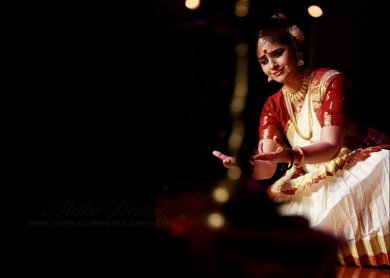
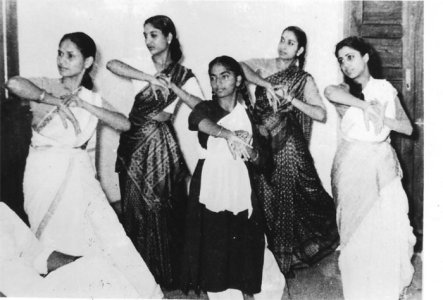
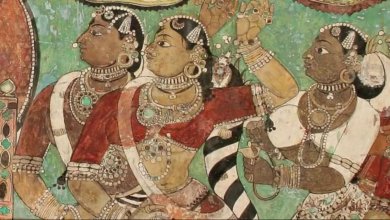
Of all papers that I have come across, a must-read is the
thesis by recent researcher Justine Alexia Lemos who has
carefully detailed out the positioning of the form of
Mohiniyattam vis-à-vis the socio-cultural context of the sambandham
or ‘alliances’ rampant in Kerala in the 19th century.
Betty True Jones has much earlier given a commendable
historical detailing of Mohiniyattam in comparison to
others but Lemos’ is a new take. For students pursuing
historical research in Mohiniyattam, common references
have for the past so many decades been P. Soman, Guru
Kalyanikuttyamma, Dr. Kanak Rele, and Leela Nambudiripad.
Every student can talk yarns about Gurus Kalyaniamma,
Kunjukutty amma, and Chinnammuamma, and their contribution
to the Kerala Kalamandalam. Vyavaharamala of the
early 18th century is the oldest reference to
Mohiniyattam. And that is because no research seems to
have gone beyond it. One also finds the novel Meenaksi
quoted regularly as a valid evidence of how the dance
became debased by the turn of the 20th century. Lemos in
her thesis ‘Bracketing Lasya; An Ethnographic Study of
Mohiniyattam Dance’ has done wonders in her first three
chapters of revealing a more convincing historical process
through which the form was resurrected. She has brought in
a whole new list of the then practitioners of Mohiniyattam
and their dance.
Read the article in the site

Kalamandalam C Gopalakrishnan and Kalakshethram, the most
popular organization standing for presenting, preserving
and propagating classical art, are inseparable.
Gopalakrishnan is the most popular Kathakali actor in
Mumbai, his teaching career spanning more than three
decades at Nalanda Nritya Kala Maha Vidyalaya as tutor /
accompanist and 28 years teaching experience in Kathakali
and eight years in Mohiniattam at Kalakshethram, Dombivli,
as honorary guru. As a nattuvanar, he has accompanied
performances of Kanak Rele in India and abroad. He has
accompanied on the nattuvangam all the senior artistes and
students of Nalanda for the past two decades as well as
provided vocal support for several Mohiniattam and
Kathakali recitals of leading artists. Gopalakrishnan
speaks about why Kathakali has few takers in Mumbai and
his passion for the most dramatic classical dance style of
India.
Why is it that Kathakali has few takers?
Kathakali is the most difficult and strenuous classical
dance among all the styles, hence that is one of the
reasons there are few takers. Moreover, unlike other
styles Kathakali is a group presentation with very little
scope for solo presentations. Normally, Kathakali is
taught and practiced only by male dancers.
Read the interview in the site
As the French would say, eet izz veery interasteeng!
Yes, what is contemporary Indian dance and where is it
headed? What is choreography? This search sets me thinking
in light of Zohra Segal’s passing away on 10th of July in
her Mandakini Enclave Delhi home, care of daughter Kiran
Segal, who lovingly looked after her for decades. Zohra
Segal represents the starting point of contemporary dance
styles as enunciated by Uday Shankar. She remained his only
dancing partner who was NOT his student (but Mary
Wigman’s). Others were attracted to his persona and came
under his influence but Zohra remained his dance partner,
like Simkie, the French artiste.
Read the article in the site
O Friend, This Waiting! is a film on Kshetrayya’s
padams by Bharatanatyam exponent Justin McCarthy and Sandhya
Kumar. Made in 2012, it won an award in art film category at
the 63rd Film Festival. It is an unusual film weaving in
poetic sensibilities of both the film makers and exquisite
visuals by cameraman Amit Mahanti.
The film of 32 minutes duration is unusual in the sense that
with the padams of the Telugu poet Kshetrayya, one expects
that there will be more of abhinaya performed by a dancer.
However, the script writers Justin and Sandhya have focused
on evoking a mood through brief words about devadasis:
sacred and profane, a maid of gods and prostitute, her
disappearance. The poems she danced portrayed intense love
for gods, then for Kings, patrons, her social status
commented upon with exquisite visuals of the river, the
palace, the flowers, the lotus leaf, a garland, two feet
with ankle bells, green leaves, interiors of the palace, old
mansion with stained glasses, school children running in a
building with old architecture- a cascade of images, often
breathtaking which linger long in memory after the film is
over.
Read the review in the site

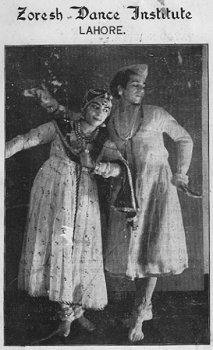
Zohra Segal was a dancer, who had worked with the legendary
Uday Shankar. Born in Sharanpurin 1912, in a large orthodox
Muslim family from Rampur, she was from a very young age of
independent temperament. After passing her matriculation
examination in 1924, she travelled with her uncle to Germany
and studied modern dance from Mary Wigman. During those
years, Uday Shankar was making his name in Europe and on
knowing about Zohra studying dance, he invited her to join
his company. When she met Uday Shankar, she had said, “I was
surprised to see a man as a dancer and thought what this
young man was doing as a dancer?But what I saw I liked very
much as it had a lot of folk element and some of the music
was based on peasant music which I loved. I thought his
partner Simkie was a Kashmiri girl because though she had a
fair complexion she had dark hair. But she had adapted
wonderfully; in her movements and feelings she was very
Indian. I liked what they did, and it made me homesick. I
thought it was beautifully presented and very colourful.” At
that time Zohra was in Dresden and wanted to return to
India.
Read the article in the site

In the death of Zohra Segal, who witnessed a century of
Indian dance and theatre, films and folk dances, an era is
gone.
Sahibzaddi Zohra Begum Mumtazullah Khan shortened to Zohra
Segal later, was born in Saharanpur, to the Rampur
nobility (Rohilla Pathan stock) on 27th April 1912. This
lady has seen a century of Indian art and has lived every
moment of it. There was no dance in her immediate
surroundings. Her mother died early and Zohra, one of
seven siblings, was sent to Queen Mary's Girls School in
Lahore as she was a bit of a tomboy and needed discipline.
The school PT drill became a source of amusement for her
and one thing led to other and she went off to Germany
with her maternal uncle Saeeduzaffer Khan, who studied
medicine at Edinburgh, in a car! Imagine in 1930s going
through Pakistan, Afghanistan, Iran, Iraq and then take a
boat from Alexandria to reach eastern "walled" Europe and
arrive in Dresden to join ballerina Mary Wigman's school?
This is stuff Zohra the great, is made of. Her training
under Wigman style made her a true talent, sought no less
by Uday Shankar when she met him backstage when he was
touring Europe with 'Shiva Parvati' and assured her a job
in his troupe once she finished her training and sure
enough when she did and returned home, she received a
telegram asking her if she would join him for his
forthcoming Japan tour. Her father was bit worried.
How to send a young girl off on a tour like this? He asked
her to think it through. While she was thinking, he went
into the bedroom and came out with a train timetable
saying, "Beta, the next train to Kathgodam is at 11.22!"
Zohra was off.
Read the article in the site
The book
‘Mohiniattam-History, Techniques and Performance’
(Mohiniattam Charithram Sindhadham Prayogam) by
Kalamandalam Sathyabhama, co-authored by her daughter
Kalamandalam Lathika Mohandas, is a delightful tapestry
featuring the story of Mohiniattam, Kerala’s classical
dance form traversing through five decades. Into it is
woven the story of Kalamandalam founded by Poet Vallathol
Narayana Menon in a historical context in the cultural
history of modern India. The memoirs of a dancer
interlacing through its web in soft vivid colors make it
greatly readable. Written in Malayalam, this is invaluable
for its texts for practitioners and lovers of Mohiniattam.
Kilimangalam Vasudeva Namboodiripad, a long time associate
of Sathyabhama in Kalamandalam introduces the book. He
praises the book for recording the visually enchanting
aspects of the dance as its uniqueness.
Spread in eleven chapters the book begins with a brief
history of Mohiniattam.
Read the review in the site