Monday, 8 June 2026

Article - The silent cry of the Gungroo - Mutation and monetization of classical dance - Dr. Lata Surendra

For generations, classical art was not merely performed; its sacredness was preserved as its strength. It lived as a sacred trust, passed from breath to breath, born of a quiet reverence for the unseen and the eternal. Today, that protective shield has shattered. Be it the lucrative choreographers or the masses who lap it all up, we are stretching the crazy urge inside in seeking to impress more than express to extreme limits.

Ananya Panday's viral Chand Mera Dil controversy is the living embodiment of a tragedy that laments the death of a sacred art form - with Bollywood just staging the execution to create an uproar all around. Panday's viral "fusion" dance was labeled a "catastrophic misunderstanding" of Bharatanatyam by eminent dancer Anita R. Ratnam. Even committed performers all over the world and critics have watched Panday's performance and watched aghast at a centuries-old spiritual discipline being reduced to aggressive, soulless modern gymnastics. Panday's team defended the act as a "creative experiment," proving the point that today you have systems that prioritize cheap entertainment over cultural guardianship.

Today's artistes view themselves merely as entertainers rather than guardians of a sacred heritage. Fearing the verdict of a profit-driven industry where artistic compromise is the price of survival, few dare to champion the true system. We watch with quiet grief as pure folk and classical traditions are butchered on the altar of reality television, reduced to mere instruments of shock value. Manmade monstrosities like "Disco Dandiya" are paraded about, stripping away the spiritual sanctity of our roots.

Read more in the site

Please type your name along with your comment. Anonymous and derogatory comments are likely to be removed.
Wednesday, 3 June 2026

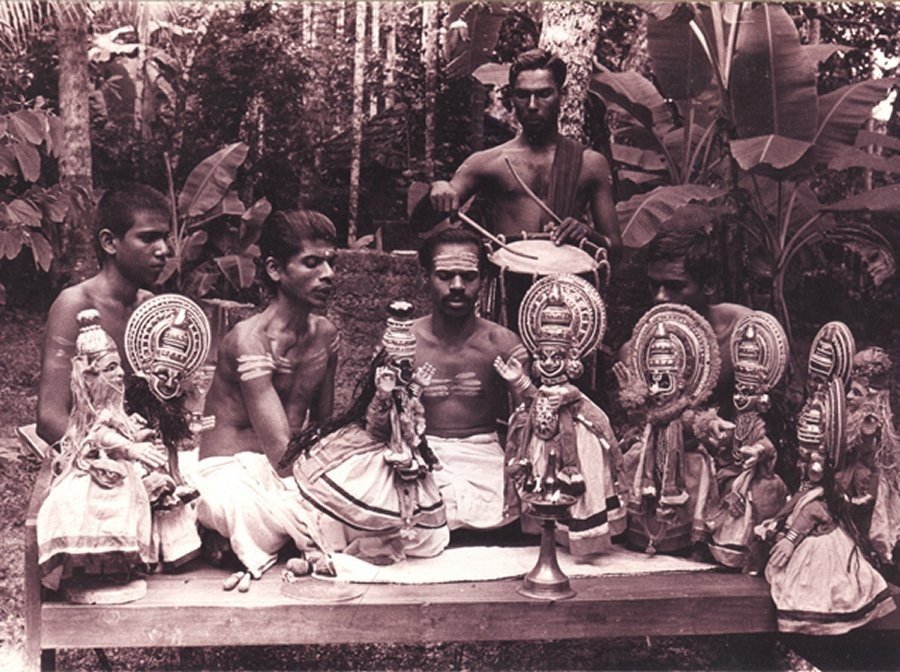
Article - From a museum artifact to a living tradition The revival of Pavakathakali in India - Vinod Gopalakrishnan


Dakshinachitra, founded as an institution of preservation, has carried a deep commitment to nurturing and sustaining India's diverse traditional Arts and crafts with a special sensitivity toward forms that survive at the margins of society and are often vulnerable to disappearance. Over the years, the museum has built a meaningful legacy not only as a custodian of living cultures, but also as an active cultural institution that recognizes 'living communities' and the artists who keep these fragile traditions alive.

Through its annual Dakshinachitra 'Virudhu' citation and Prize, the institution has consistently acknowledged individuals and groups whose lifelong dedication have strengthened the continuity of folk and traditional arts across India. 

In 2026, this honor was bestowed upon the Pavakathakali performing team leaders of the Natanakairali ensemble from Kerala. Kunnambath Sreenivasan and Kauthiyam Parambu Ramakrishnan were nurtured under the guidance of Guru G. Venu - the visionary Kudiyattam artiste and Navarasa Sadhana Guru whose dedicated pioneering work in reviving endangered performance traditions is extraordinary.

Read more in the site

Please type your name along with your comment. Anonymous and derogatory comments are likely to be removed.

Tuesday, 2 June 2026

Blend of experienced and aspiring dancers - Taalam: column by Leela Venkataraman

Milind Srivastava's Art Foundation, with World Dance Day round the corner, celebrated its own annual effort at the Habitat Centre, Delhi, featuring both experienced and aspiring talents. The curtain raiser was a short Modern Dance item conceived and choreographed by puppeteer Salim Zaidi, titled Samhrti - 'an exploration of existence and transcendence through the art of dance.' The performance looks at the cyclical nature of the Universe with the eternal rhythms of creation and dissolution....

At the Habitat, the World Dance Day celebration brought together in one program, not just all Indian dance forms, including classical and tribal, but also international groups from countries like Indonesia, Cambodia, Bangladesh, and a mixed African group. The event essentially stressed togetherness and bonhomie - represented through dances pertaining to various cultures - each with a distinctive identity. Mohiniattam dancer (who also teaches Bharatanatyam) Jayaprabha Menon, the choreographer, within the very short time she had for planning, wisely decided to enlist the help of foreign students studying in different colleges of Delhi. In what became a variety program of dance, each of the groups was given a separate slot of a few minutes, before coming together in the finale....

Fighting against very heavy traffic, I reached IIC too late to take in the starting item of dancer Amrita Lahiri's Kuchipudi program. The second item comprising a scene from the full length dance drama Usha Parinayam, revealed a dancer whose Bharatanatyam training with its linear geometry, has not influenced or detracted in any way, the mercurial grace and lyrical sensuality of Kuchipudi, which is in a compartment of its own, with her training under Jaikishore Mosalikanti and his wife Padmavani....

Yet another double bill presentation at the India International Centre, saw a very finished Bharatanatyam performance by Satvikaa Shankar, trained under Chennai's Anitha Guha. After gaining special accolades for her performance as Hanuman, it was a vastly different Margam dancer one witnessed with her opening comprising a rare varnam in Kalyani, a composition of Sivanandam of the Tanjore Quartette, addressed to the great patron of Arts, Maharaja Shivaji II, "Sarasa shikhamani neevani tsala nammiti." Set to dance by the dancer herself under the overall guidance of her guru, she specially mentioned her gratitude to both Nandini Ramani and Anupama Kylash for their help in better understanding the varnam.....

At the Shri Ram Centre, Kathak students of Sanskriti Foundation, the institution run by Gauri Diwakar, presented an evening of dance. With youngsters and the more advanced students participating, the program understandably, of varying standards, shared one pleasing feature, which was seeing all participants of different groups, turned out in simple salwar/kameez outfits of varying colours, deriving joy out of the entire enterprise.  

Read more in the site

Please type your name along with your comment. Anonymous and derogatory comments are likely to be removed.

Monday, 1 June 2026

Anita says...June 2026

May was a series of immensely theatrical spectacles. And none were about dance!

I will, of course, blend my month of observations and reflections into our world of dance, but not before casting a wider lens on the very idea of PERFORMITIVITY that has permeated every sphere of our waking moments.

I begin by converging the three grand events of Fashion, Sports and Politics. While they may represent entirely different worlds, in May, all three genres demonstrated a remarkable convergence of productivity, performance, precision and theatricality. Each became a grand stage where discipline and spectacle fused in ways that rivalled the dazzle of Broadway and the excesses of Las Vegas and Bollywood. 

Read more in the site

Please type your name along with your comment. Anonymous and derogatory comments are likely to be removed.